
Nobody thinks about the water heater until the shower goes cold. Then it's the only thing anyone in the house can think about.
The first question is usually whether it can be fixed or whether it's time for a new one. The honest answer comes down to how old the tank is, what's actually wrong with it, and what a repair costs compared to a replacement.
Late Winter Is When Old Tanks Give Out
Year after year, we see more water heater failures in late winter and early spring than any other time. All winter long, the water coming into your house is ice cold, so your tank works harder and runs longer just to keep up. An older tank can only take that strain for so long, and the end of winter is usually when it gives out.
When an old tank fails, it doesn't always quit quietly. A tank that has rusted through can let go and send water across the basement floor, soaking whatever is down there. If your water heater is 10 years old or more, it's worth thinking about a replacement now, on your schedule, instead of after a leak and in the middle of the spring rush.
Problems That Are Usually Worth Repairing
A lot of water heater trouble comes down to one part, not the whole unit.
- No hot water from an electric tank. Often a burned-out heating element or a bad thermostat. Both can be replaced.
- The pilot won't stay lit on a gas or propane tank. Usually a sensor or control part, and a fairly common fix.
- Hot water that smells like rotten eggs. This is usually a reaction between the anode rod and bacteria in the water, and it's common with well water. Swapping the anode rod often clears it up. If you smell gas around the water heater itself, that's a different story. Leave the house and call your gas utility or propane supplier from outside.
- Rumbling or popping from the tank. That's sediment built up on the bottom. Flushing the tank can help if it's caught early.
- Water coming out of the relief valve pipe. The temperature and pressure relief valve is either failing or doing its job because something is running too hot or too high. Either way, have it checked, and never cap or plug that pipe.
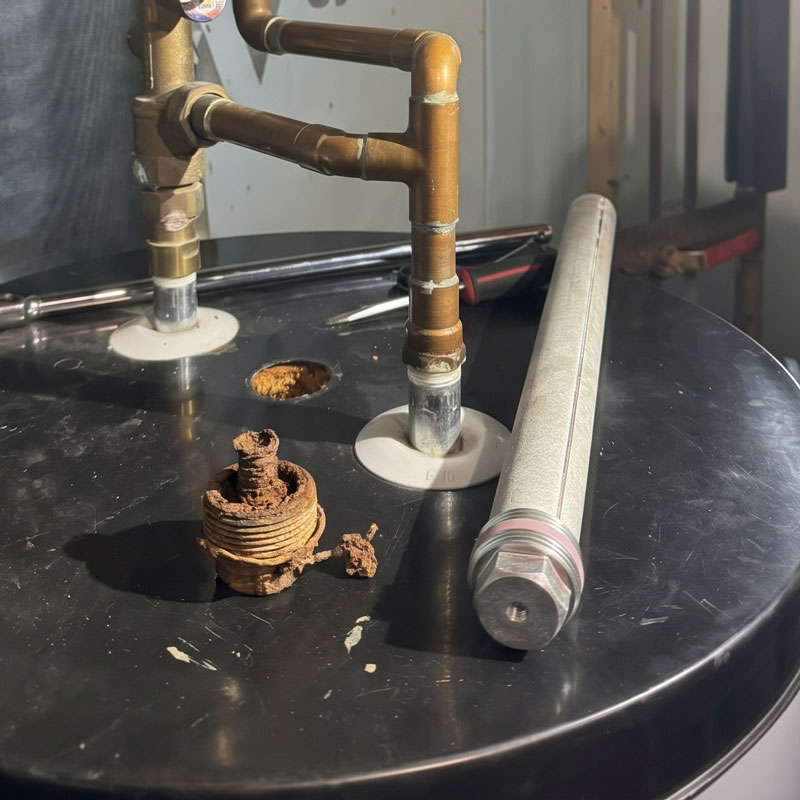
- A worn-out anode rod. The anode rod takes the corrosion so your tank doesn't have to. Replacing it before it's eaten away can add years to a tank. See example below:
When Replacement Makes More Sense
Some problems aren't worth throwing money at.
- The tank is leaking. If water is pooling around the base and it's coming from the tank itself rather than a fitting or valve, the tank has rusted through. There's no fixing that.
- It's past 10 years old. Most tanks last around 12 years. Putting a big repair into one that age is usually a gamble.
- Your hot water is rusty. When only the hot side comes out discolored, the inside of the tank may be corroding.
- The repairs keep coming. One repair is normal. A service call every few months means the tank is wearing out.
- You never have enough hot water. If your household has grown, the tank you have may just be too small for how you live now.
A Simple Way to Decide
If the tank is fairly young and the problem is a single part, repair usually makes sense. If it's past 10 years and the repair is a big one, that money is usually better spent toward a new unit. If the tank itself is leaking, replace it.
For everything in between, we'll look at it and give you a straight answer. If a repair will get you several more good years, we'll tell you that.
If You're Replacing, Look at Your Options
Swapping in the same tank you had is the easy choice, but it isn't the only one. Depending on your home and fuel, you might be a good fit for a tankless unit that heats water on demand, an indirect tank that runs off your boiler, or a hybrid heat pump water heater. Heat pump water heaters use far less electricity than a standard electric tank, and Efficiency Vermont offers rebates and low-cost loans on qualifying models.
We recently helped a family in Fairfax whose 80-gallon indirect tank sprang a leak. Instead of a straight swap, they upgraded to an 80-gallon heat pump water heater. Our Water Heaters page walks through each type in more detail.
Hot Water Service Across Northwest Vermont
Brock's handles water heater repair and replacement across most of Franklin and Chittenden counties, all of Grand Isle County and parts of Lamoille County. When we put in a new unit, we haul the old one away, and every install is backed by our 3-year materials and workmanship warranty.
Beat the Rush
If your water heater is 10 years old or more, don't wait to be the one dealing with a leaking tank in March. Get on our schedule now for a new one. And if your hot water is already giving you trouble, we'll get it back, whether that takes a quick repair or something new. Call Brock's at 802.849.2466 or request service online.